

Most people think decisions come from logic. Trial lawyers know better. Decisions come from how information is presented, how it is filtered, and how it feels in the moment.
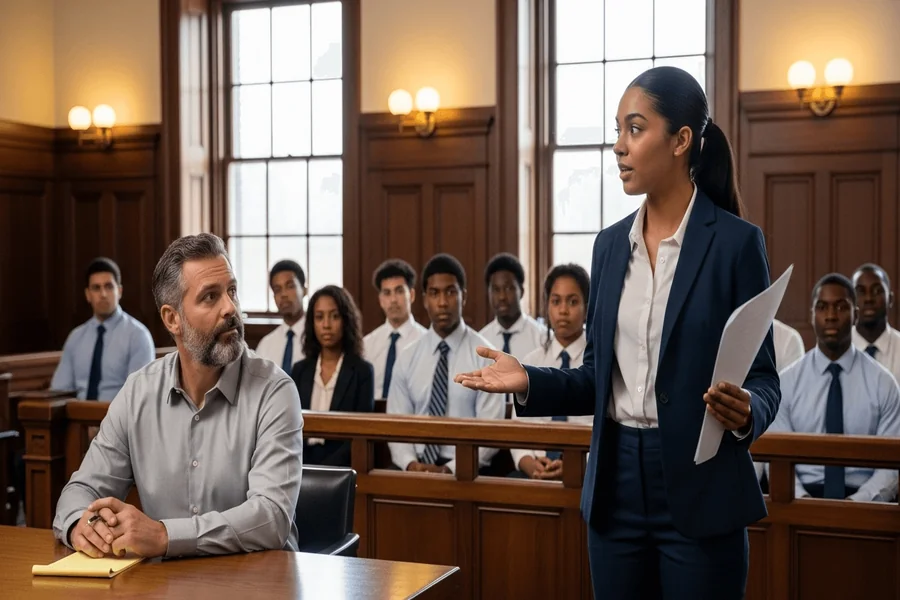
A courtroom is one of the few places where decision-making is tested in real time. Twelve people sit down with no prior knowledge of the case. They hear weeks of arguments. Then they decide. No rewinds. No second passes. That pressure reveals how people actually think.
Trial lawyers build everything around that reality.
People Don’t Process Everything. They Filter.
Cognitive science shows that working memory can hold about 4 to 7 items at once. That is the ceiling. Anything beyond that gets dropped or ignored.
In a trial, this limit becomes obvious quickly. If a lawyer presents ten arguments, jurors remember two or three. The rest fades.
One trial lawyer described a case involving complex storage systems. “We started with eight technical points. Jurors looked lost by day two. We cut it down to three. Same evidence. Suddenly, everything clicked.”
The lesson is simple. People do not absorb more because you give more. They absorb less.
Order Changes Everything
The same information can lead to different decisions depending on the order. Behavioral research has shown that early information frames how later information is interpreted. This is called primacy bias.
In court, the first explanation of a case often sticks, even if it is later challenged.
One attorney recalled shifting the order of an opening statement. “We used to start with technical details. People tuned out. We flipped it. We started with a simple timeline. Same facts, different order. The room changed.”
This is not about manipulation. It is about how people build understanding.
People Decide on Meaning, Not Detail
Facts matter. But meaning matters more.
Studies on jury behavior show that jurors build stories to make sense of evidence. They are not listing facts. They are creating a narrative.
In one patent case, a team presented detailed diagrams and specifications. The opposing side used a simple story about fairness and broken agreements. The simpler story carried more weight.
A trial lawyer put it bluntly: “We had better facts. They had a better story. That was the difference.”
This pattern shows up everywhere. People want to understand what something means, not just what it is.
Too Much Preparation Can Backfire
Preparation is essential. Over-preparation is a risk.
Research on decision fatigue shows that performance drops as mental load increases. The same applies to preparation. At a certain point, more material creates confusion.
In one case, a team built hundreds of slides. They knew every angle. During trial, they struggled to choose what to present. The result was a scattered argument.
Another team used fewer materials. They focused on a small number of points. Their delivery was sharper.
“Preparation should narrow your focus,” one lawyer said. “If it expands it, you’re doing it wrong.”
Credibility Beats Intelligence
People do not choose the smartest option. They choose the most credible one.
Research on persuasion shows that trustworthiness and clarity outweigh technical expertise. In juries, this effect is strong.
In one trial, an expert witness had top credentials but spoke in dense language. The opposing expert explained ideas simply and admitted uncertainty when needed. The jury trusted the second witness more.
“Jurors told us after the case that they trusted the person who sounded like they were explaining, not performing,” one lawyer shared.
This applies beyond courtrooms. People respond to signals of honesty and clarity.
Constraints Improve Thinking
Trial lawyers operate under strict constraints. Time limits. Evidence rules. Limited attention.
These constraints force better decisions. They eliminate unnecessary material.
One team had 30 minutes to explain a case that could take weeks to explain. They reduced it to a timeline, three themes, and a few key exhibits.
“Time limits force discipline,” a lawyer said. “Without them, you say too much.”
In other settings, the absence of constraints leads to clutter.
People Want Closure
Uncertainty creates discomfort. People look for closure.
In trials, jurors want a clear path to a decision. If the argument leaves too many open questions, they hesitate or default to the simplest option.
Studies show that when faced with ambiguity, people often rely on shortcuts or default positions.
One case involved multiple competing explanations. The team that provided a clear, single path to a conclusion had the advantage.
“We gave them a way to decide,” a lawyer said. “Not just information.”
Tools Help, But They Don’t Decide
Technology has changed how information is handled. Over 70% of professionals now use AI tools to manage information.
These tools can organize and surface patterns. They cannot decide what matters.
Jason Sheasby once described using software to sort through large volumes of technical documents. “It helped us find patterns faster,” he said. “But it didn’t tell us which ones mattered. That part still required judgment.”
This distinction is critical. Tools reduce noise. They do not replace thinking.
The Bottom Line
Trial lawyers see decision-making in its raw form. No filters. No second chances. That environment exposes patterns that apply everywhere.
People filter information. They respond to order. They build meaning. They trust clarity. They struggle with overload.
Better decisions come from respecting these patterns.
Limit what you present. Structure it clearly. Focus on meaning. Build trust through simplicity.
That is what trial lawyers know. And it is what most people miss.
